
Conversion Rate Optimisation
Stop guessing which version is better. Find out.
A $2,450 CRO Audit runs quantitative and qualitative research across your highest-traffic pages and produces a ranked, evidence-backed test roadmap. Three weeks, and you keep it whoever runs the tests.
Velocity beats brilliance
Roughly one test in three produces a clear win. That ratio is stable across the industry and it means the number of experiments you run matters more than how clever any single one is. Programmes that ship two tests a month beat programmes that agonise over one.
Scope
This is the ongoing programme, not the rebuild.
If your funnel needs building or a landing page needs creating from scratch, that is funnel and landing page work, priced as a project. This service is what happens afterwards: continuous experimentation across pages that already exist and already receive traffic.
Plenty of companies need both, in that order. Testing a page that is fundamentally wrong optimises a losing position, so we will tell you when a rebuild should come first even though the retainer would bill for longer.
The economics
Cheaper than buying more traffic, and permanent.
A conversion improvement applies to every visitor from that point forward, including the ones you already paid for. It is the only marketing investment that makes every other channel cheaper at the same time.
1 in 3
tests produce a clear winner, which is why velocity matters
2% to 4%
doubling conversion equals doubling traffic, at a fraction of the cost
~50%
of tests lose or stay flat, and those are reported in the same detail
Method
Research first. Always.
Button colour tests are what CRO looks like when nobody did the research. We start with session recordings, form analytics, exit surveys, heat maps and sales call transcripts, because those tell you what is actually confusing people.
Observations become hypotheses, hypotheses get prioritised by expected impact and effort, and only the top of that list gets built. Most observations never become tests, which is the point of prioritising.
What gets tested
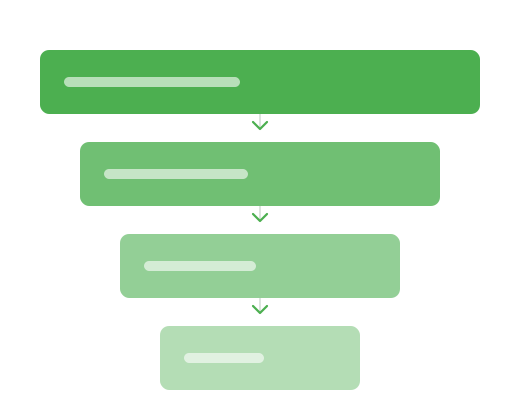
Six variables, in order of impact.
Ranked by how often each turns out to be the thing that mattered, rather than by how easy it is to change.
Offers and incentives
The most powerful variable and the least tested. What you ask for and what you give in return moves conversion further than any layout change.
Headlines and messaging
What the page claims in the first three seconds, tested against what buyers actually said they cared about.
Forms
Field count, ordering, labelling, validation and whether the ask matches the stage of the relationship.
Social proof
Which proof, positioned where. Evidence placed at the moment scepticism peaks outperforms a testimonial block at the bottom.
Page structure
Order of sections, length, and whether the primary action appears before people decide to leave.
Pricing presentation
How plans are framed, ordered and anchored. In SaaS this frequently returns more than anything else on the list.
Discipline
Calling a test early is how you get fake wins.
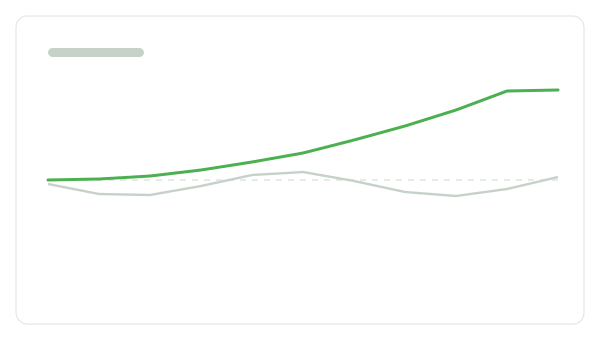
Every test looks decisive on day three. Stopping when the numbers look good is the single most common way companies convince themselves of improvements that were never there.
Sample sizes are calculated before a test starts, run times are agreed in advance, and results are read when the test concludes rather than when someone gets impatient. A test that stays inconclusive is reported as inconclusive.
The cycle
What a month looks like.
Repeated continuously. The compounding comes from the repetition, not from any single test.
Week 1
Research and hypotheses
New observations gathered, hypotheses written with a predicted outcome and a falsification condition.
Week 2
Build and QA
Variants built, tested across browsers and devices, tracking verified before anything goes live.
Week 3 to 4
Run
Test runs to its predetermined sample size. No peeking, no early calls, no stopping because it looks good.
End of month
Analyse and report
Result read, learning documented, winner deployed or hypothesis retired. Losses reported in the same detail as wins.
Prerequisite
Testing needs volume to be honest.
Statistical testing requires enough conversions to distinguish a real effect from noise, which in practice means a few hundred conversions per month on the page being tested. Below that, tests either never reach significance or produce results that will not replicate.
If you are under that threshold we will say so during the audit and recommend research-led rebuilds measured before and after instead. It is a smaller engagement and it is the honest one.
Fit
Who this works for.
Good fit
- Several hundred conversions monthly on key pages
- Meaningful spend driving traffic to those pages
- Willing to test the offer, not only the layout
- Someone can approve copy changes within days
- Analytics trustworthy enough to read results
Not yet
- Low conversion volume where tests cannot resolve
- Pages that need rebuilding rather than refining
- Nobody empowered to change the offer
- Tracking currently unreliable
- You want a redesign, not a measured outcome
Pricing
Published CRO pricing.
CRO engagements commonly run $1,500 to $30,000 per month depending on traffic and funnel complexity, with one-time audits at $2,000 to $15,000. These sit in the lower-middle of those bands with test volume stated rather than implied.
CRO Audit
Evidence before experiments.
$2,450
one-time
- Quantitative funnel analysis
- Session recordings and heat maps
- Exit surveys and user feedback
- Sales call transcript review
- Ranked test roadmap
- Yours to keep
Most chosen
Testing Programme
Steady, disciplined velocity.
$3,950
per month
- Two tests per month
- Research and hypothesis writing
- Build, QA and deployment
- Analysis and documentation
- Monthly reporting
- Three month minimum
Growth Testing
Higher velocity, deeper research.
$7,450
per month
- Four to six tests monthly
- Multiple templates in parallel
- Personalisation experiments
- Ongoing qualitative research
- Fortnightly working sessions
Enterprise Testing
Multiple properties at scale.
$13,950
per month
- High-velocity experimentation
- Multiple sites or regions
- Dedicated analyst
- Custom instrumentation
- Weekly reporting and reviews
All prices in USD and exclude testing platform subscriptions, which you own directly.
Questions
Common questions.
How much does CRO cost?
Conversion rate optimisation engagements typically run $1,500 to $30,000 per month depending on traffic volume and funnel complexity, with one-time audits between $2,000 and $15,000. marive publishes fixed pricing: $2,450 for a CRO Audit, then $3,950, $7,450 or $13,950 per month by testing velocity.
How much traffic do we need for A/B testing?
Enough to reach statistical significance, which in practice means at least a few hundred conversions per month on the page being tested. Below that threshold tests either never resolve or produce results that do not replicate, and research-led rebuilds measured before and after are the honest alternative.
How many tests will actually win?
Roughly one in three produces a clear winner, and that ratio is stable across the industry. It is why test velocity matters more than the cleverness of any individual experiment, and why a programme promising a high win rate is either cherry-picking or not testing rigorously.
What is the difference between this and your funnel service?
Funnel and landing page work builds or rebuilds pages that do not exist or do not work, priced as a project. This service is ongoing experimentation on pages that already exist and receive traffic. Many companies need the rebuild first, and we will say so rather than test a page that is fundamentally wrong.
How long before we see results?
The first cycle is spent establishing baselines and running initial hypotheses, so meaningful wins usually appear in the second or third month. Compounding becomes visible around month six, once several validated improvements are stacked on the same funnel.
What happens when a test loses?
It gets reported in the same detail as a win, because a loss that explains something about your buyer is more valuable than an unexplained win. Around half of all tests lose or stay flat, and any programme reporting only successes is not testing honestly.
Can you test without touching our codebase?
Usually yes, through a client-side testing tool for most experiments. Deeper changes to forms, pricing pages or logic often need developer involvement, and we scope that with you rather than pretending everything can be done in a visual editor.
Which testing tools do you use?
Whatever you already have, if it is adequate. Where you have nothing, we will recommend based on your traffic volume and technical setup rather than defaulting to the most expensive platform. Tool licences stay in your name.
Related services
What testing depends on.
Sales Funnel & Landing Pages
Build it before you optimise it.
Analytics, Tracking & Reporting
Testing needs numbers you trust.
Campaign Creative Direction
New angles to test, not just new buttons.
Start with evidence, not opinions.
The CRO Audit costs $2,450 and takes three weeks. Research across your highest-traffic pages and a ranked test roadmap you keep, whether or not we run the programme.